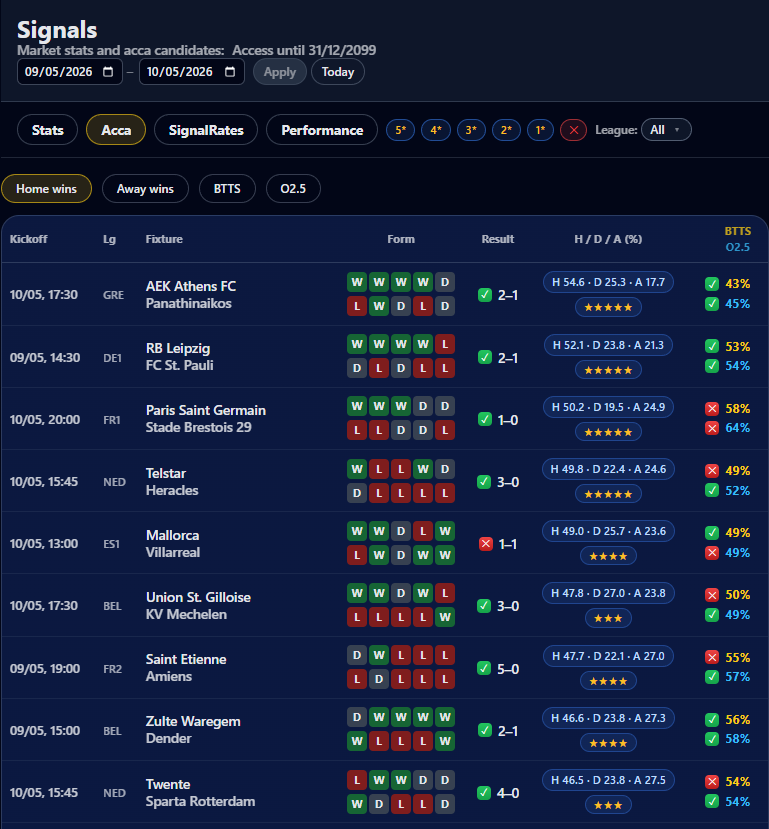
Most accumulators are built the same way. You pick a handful of matches where you have a vague feeling about the result, add them together, and hope. Some win. Most do not. The underlying reasoning is rarely examined.
BetSignals gives you a way to approach each leg with actual data behind it. This guide covers how to use that data when building a multi.
---
Start with the signal, not the fixture
The instinct is to pick fixtures first ("Chelsea are at home, I'll include them") and look for data to confirm the choice afterwards. That is confirmation bias in action, and it produces poor selections.
The smarter approach is to start from the data. Open the signal board and look for matches where the model has produced a ★★★★ or ★★★★★ signal rating. These are fixtures where both models agree on the dominant outcome and the model probability is meaningful. That is your starting pool.
---
Use signal strength to grade legs
Not every leg in an accumulator should carry equal weight in your selection process.
★★★★★ signals are your anchor legs. Both models agree and the probability exceeds 50%. These are the selections with the clearest data support. Build your acca around these first.
★★★★, ★★★ & ★★ signals are solid supporting legs. Both models agree and the probability is between 40% and 50%. Use them to extend a well-founded acca if the price warrants it.
★ signals are weaker. The data leans one way but not decisively. These are worth including as a final leg only when you have strong additional context (such as an injury to the opposition's key attacker, or a particularly poor recent defensive record) that the model does not capture.
✕ signals should generally be left out of accumulators. The models disagree. That is not a basis for a high-stakes leg.
---
Check the price, not just the signal
A ★★★★★ signal is data alignment, not a guaranteed result. You still need to check whether the odds represent value.
For each potential leg, compare the model's win probability against the bookmaker's implied probability in the odds. If the model gives a 58% win probability and the bookmaker implies 55%, the edge is small. If the model gives 58% and the bookmaker implies 48%, that is a meaningful gap worth acting on.
In an accumulator, this gap compounds across legs just as the bookmaker margin does. Building a four-fold where each leg has a genuine positive edge puts the mathematical advantage with you, not against you.
---
BTTS legs: a data-backed approach
BetSignals produces BTTS probabilities from the model for every fixture. BTTS is a popular acca leg because the odds are accessible and the rationale is simple.
When selecting BTTS legs, look for matches where:
- The model's BTTS probability is materially higher than the bookmaker's implied BTTS probability
- Both teams have poor recent defensive records
- Form data shows a high BTTS rate in recent matches for both sides
Adding a BTTS leg on gut feel ("this looks like a goal-fest") is different from adding one where the model probability, the odds, and the recent data all point the same way.
---
How many legs is the right number?
There is no universal answer. More legs means higher potential return and lower probability of winning.
A practical discipline: build the acca from strong data legs first, and stop when you run out of well-supported selections. Do not add a sixth leg because five feels like it needs company. An underpowered six-fold is worth less than a sharp treble.
Three to five legs, each with genuine data support and a positive edge on the price, is a reasonable target for a structured approach.
---
What signals do not replace
BetSignals provides model probabilities. They do not know about last-minute team news, a manager's tactical switch, or a dressing-room dispute. Before you finalise an accumulator, a quick check of each team's confirmed lineup and any relevant news is still worthwhile. The model provides the data baseline; your knowledge of context layers on top.
---
A simple process to follow
1. Open BetSignals and filter for ★★★ signals on fixtures in the coming gameweek
2. For each, compare the model win probability against the bookmaker's implied probability
3. Include legs where the model probability meaningfully exceeds the implied probability
4. Add ★★ legs if the price gap is there
5. Check for late team news on each selection
6. Decide on your stake using your normal bankroll management rules
That is it. No mystical process. Just data, odds comparison, and consistent discipline.
---
Next reads
- How Accumulators Work: the maths behind combining multiple selections
- Understanding Signal Ratings: what ★, ★★, and ★★★ mean and how they are calculated
- What is a Value Bet?: why checking the price matters as much as picking the selection
---
18+ | Gambling should be enjoyable. If it stops being fun, take a break. For support and advice visit BeGambleAware.org. See our full responsible gambling guide.